How 420 Started
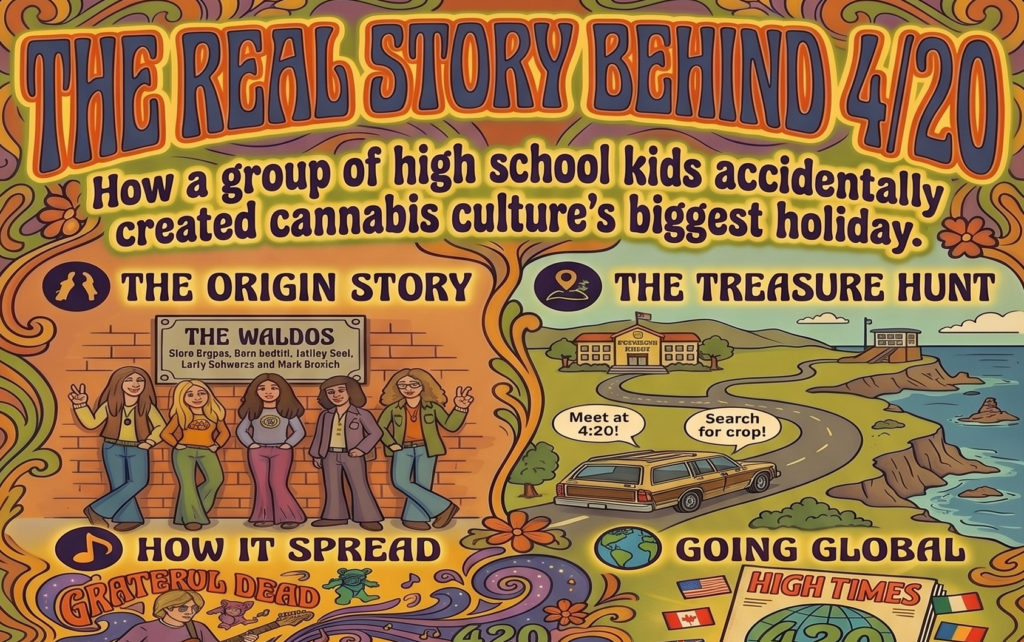
Five high school kids, a treasure map, a dead rock band, and one very persistent rumor mill. Here’s how a random number became the most celebrated date in cannabis history.
Planet 13 Florida · Patient Education · April 2025
Every April 20th, millions of people around the world pause at 4:20 in the afternoon — or celebrate the date itself — in honor of cannabis. It’s a tradition so widespread it’s become almost impossible to ignore. But where did it actually come from? The real origin story is wilder, more specific, and way more fun than most people know.
Meet the Waldos
The story begins in 1971 at San Rafael High School in Marin County, California. A group of five friends — Steve Capper, Dave Reddix, Jeffrey Noel, Larry Schwartz, and Mark Gravich — gave themselves the nickname “the Waldos” because they liked to hang out by a particular wall on campus.
One autumn, the Waldos got their hands on a hand-drawn treasure map. According to the story, a Coast Guard serviceman who grew cannabis near Point Reyes had abandoned his crop and passed the map to a friend of a friend. The Waldos hatched a plan: meet after school at 4:20 p.m., by the statue of Louis Pasteur outside the school, and go hunt for the stash.
They never found the crop. But somewhere along the way, “4:20 Louis” — their code for the meetup — got shortened to just “420.” They used it as a private signal. “Hey, you 420?” meant: are you down to smoke after school? It spread through their friend group and eventually became their all-purpose shorthand for cannabis.
We’d remind each other in the hallways: ‘4:20, Louis.’ Then it was just ‘420.’ It was like a code.
The Grateful Dead Connection
Here’s where the story goes national. One of the Waldos — Dave Reddix — had connections to the Grateful Dead. His older brother managed a sideproject for Dead bassist Phil Lesh, and Reddix eventually became a roadie for the band. He brought the term “420” directly into the inner circle of one of the most influential touring acts in American music.
The Grateful Dead were famous for their wandering, communal, cannabis-friendly touring culture. Deadheads — the devoted fan base that followed the band from city to city — shared slang, rituals, and inside jokes the way most people share phone numbers. “420” traveled in that current. By the 1980s, it had spread from California to concert venues across the country.
In December 1990, Deadheads in Oakland handed out a flyer that explicitly invited people to smoke “420” on April 20th at 4:20 p.m. That flyer found its way to Steven Hager, the editor of High Times magazine — and the rest, as they say, is history.
High Times and the Global Spread
Hager ran with it. Throughout the early 1990s, High Times published references to 420 and began championing April 20th as an unofficial cannabis holiday. With the magazine’s enormous reach in counterculture circles, the term exploded. By the mid-90s, it had taken on a life of its own — appearing on bumper stickers, in song lyrics, in movies, and eventually on T-shirts in every mall in America.
In 2003, California passed Senate Bill 420, which regulated medical cannabis use under the Compassionate Use Act. Whether the bill number was chosen deliberately or was pure coincidence has never been fully confirmed — but it only cemented 420’s place in cannabis law and culture forever.
Today, April 20th draws tens of thousands of people to public celebrations in Denver, San Francisco, Vancouver, London, and beyond. What started as a coded meetup between five teenagers has become an internationally recognized day of cannabis community, advocacy, and culture.
A Quick Timeline
1971
The Waldos Meet at the Wall
Five friends at San Rafael High School begin using “420” as a private code for their post-school cannabis meetups.
Late 1970s–80s
Into the Dead’s World
Through their connections to the Grateful Dead’s inner circle, the Waldos’ slang enters the Deadhead touring community and begins spreading across the U.S.
1990
The Oakland Flyer
A printed flyer circulates among Deadheads in Oakland inviting people to “smoke 420” on April 20th at 4:20 p.m. High Times editor Steven Hager gets a copy.
Early 1990s
High Times Makes It Official
High Times runs consistent coverage of 4/20, cementing April 20th as a cannabis cultural holiday in the minds of readers across the country and the world.
2003
California SB 420
California passes Senate Bill 420, providing guidelines for medical cannabis use. The bill number becomes a pop culture punchline — and a permanent footnote in cannabis law.
Today
A Global Holiday
April 20th draws millions of participants worldwide — from large-scale public gatherings to intimate moments shared between patients and the plant they rely on.
Clearing Up the Myths
420 is one of the most myth-plagued numbers in pop culture. Over the decades, some pretty creative (and completely false) origin stories have circulated. Let’s put a few of them to rest.
Myth
“420 is a California police code for cannabis.”
There’s no such code. It simply doesn’t exist in California’s penal code or any law enforcement radio system.
Myth
“It comes from Bob Dylan’s ‘Rainy Day Women #12 & 35.'”
The math checks out (12 × 35 = 420), but there’s zero evidence Dylan chose those numbers for that reason. Fun coincidence, not origin story.
Myth
“420 is the number of active chemicals in cannabis.”
Scientists have identified over 500 compounds in the plant. The number 420 has no special chemical significance.
Myth
“April 20th is chosen because it’s Bob Marley’s birthday.”
Marley was born on February 6th, not April 20th. His legacy is enormous — but he’s not the source of this one.
The documented origin — the Waldos, the treasure map, the Grateful Dead — has been confirmed through physical evidence, including original letters and a “420” flag the Waldos saved from 1971. The story is real. The myths are just myths.
What 4/20 Means Now
For many patients and consumers, April 20th has evolved well beyond its origins into something more meaningful: a moment to recognize how far cannabis has come, and how far it still has to go. In Florida, medical cannabis patients have had legal access to this plant since 2016 — a hard-won right that took years of advocacy, education, and community organizing to achieve.
At Planet 13 Florida, we think about 4/20 as a reminder of why patient education matters. The more people understand about the plant — its history, its compounds, how it interacts with the body — the better equipped they are to make informed choices about their care. That knowledge doesn’t just benefit individuals. It moves the whole conversation forward.
So whether you mark the day quietly or celebrate with everyone you know — here’s to the five kids from Marin County who unknowingly gave the whole world a reason to show up at 4:20.
Curious About Cannabis in Florida?
Stop by any of our 33 Florida locations to speak with a knowledgeable Patient Consultant — or explore our patient education resources online.
DISCLAIMER
This content is for educational purposes only and does not constitute medical advice. Planet 13 Florida is a licensed Medicinal Marijuana Treatment Company. Medical cannabis in Florida requires a valid physician recommendation and OMMU registration. No cannabinoid compound discussed herein is FDA-approved for the treatment, cure, or prevention of any disease or condition, except where explicitly stated (e.g., Epidiolex for epilepsy). Research cited represents the current state of scientific inquiry and should not be interpreted as established clinical guidance. Consult your physician before making any changes to your wellness plan.
Planet 13 Florida operates 33 dispensary locations across the state of Florida as a licensed Medical Marijuana Treatment Center (MMTC). Florida law requires a physician recommendation to purchase medical cannabis products.
© Planet 13 Florida | Patient Education Series