When patients first explore medical cannabis, they often hear that cannabis “works with your body’s own system.” That system has a name — the endocannabinoid system, or ECS — and understanding it is one of the most valuable pieces of foundational knowledge any patient can have.
The ECS is not a system that was built for cannabis. It is a system your body already has, evolved over hundreds of millions of years, that helps regulate some of the most essential biological functions you have — sleep, mood, pain, appetite, immune response, and much more. Cannabis works the way it does because its compounds interact directly with this system.
This guide explains what the ECS is, how it works, what research has revealed about it, and what it means for you as a Florida medical cannabis patient.
| 🔬 Why This Matters for Patients The ECS is the biological foundation of medical cannabis. Understanding it helps you make more informed decisions about products, cannabinoid ratios, delivery methods, and conversations with your physician. It also explains why cannabis affects different patients differently — and why there is no one-size-fits-all recommendation. |
The Discovery of the Endocannabinoid System
The ECS was not discovered until the early 1990s — remarkably recent for a system this fundamental to human biology. Its identification was a direct result of cannabis research, which is part of why the system carries the name “endocannabinoid” (endo meaning “within” or “internal”).
In 1988, pharmacologist Dr. Allyn Howlett and her team at Saint Louis University made a pivotal discovery: there were specific receptor sites in the brain that responded to THC, the primary psychoactive compound in cannabis. This was the first identified cannabinoid receptor, later named CB1.
In 1992, Israeli researcher Dr. Raphael Mechoulam — the same scientist who first isolated and identified THC in 1964 — led the team that discovered the first known endocannabinoid: a naturally occurring compound produced by the body itself that bound to those same CB1 receptors. He named it anandamide, from the Sanskrit word for bliss, “ananda.”
A second major endocannabinoid, 2-arachidonoylglycerol (2-AG), was identified in 1995. A second receptor type, CB2, was also mapped and described during this period. Together, these findings established that the body maintains its own internal cannabinoid signaling system — one that existed long before humans ever used the cannabis plant.
| 📖 Key Research Milestone A landmark 2013 review by Dr. Vincenzo Di Marzo, published in Nature Reviews Drug Discovery, described the ECS as “perhaps the most important physiologic system involved in establishing and maintaining human health.” This framing has since become a touchstone in cannabinoid medicine education. |
The Three Core Components of the ECS
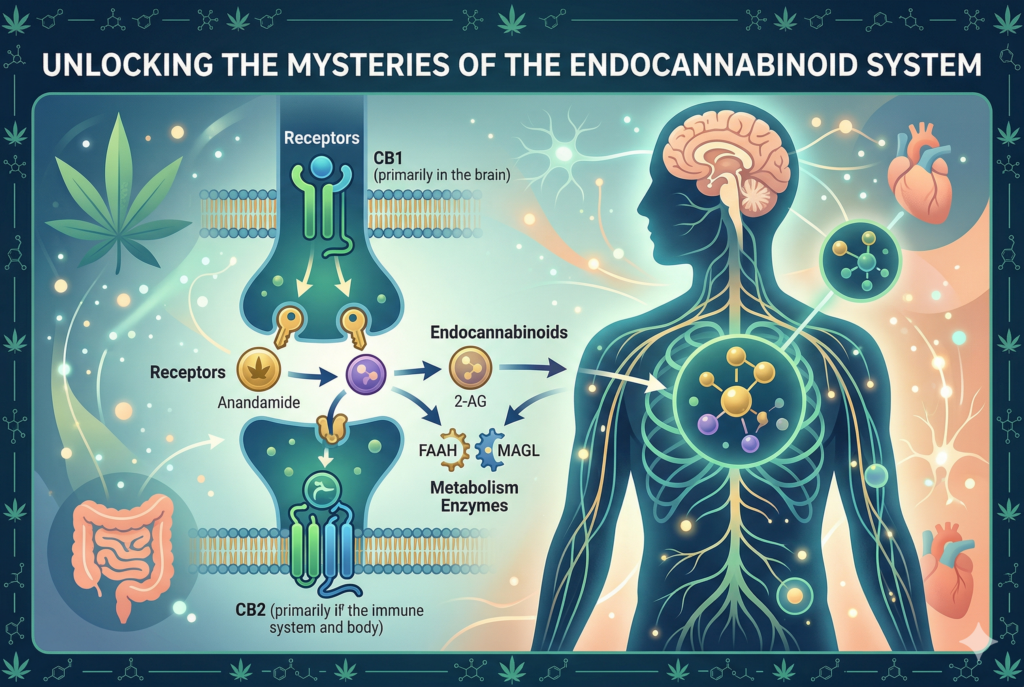
The endocannabinoid system has three main parts that work together to maintain internal balance, a process called homeostasis:
1. Endocannabinoids
Endocannabinoids are signaling molecules produced naturally by your body. Unlike most neurotransmitters, they are synthesized on demand — made when needed, used immediately, and then broken down. The two most studied are:
| Anandamide (AEA) | 2-Arachidonoylglycerol (2-AG) |
| Named from the Sanskrit word for bliss Binds primarily to CB1 receptors Associated with mood regulation, pain modulation, and memory Structurally similar to THC — explaining why THC binds the same receptors Broken down by the enzyme FAAH | The most abundant endocannabinoid in the body Binds to both CB1 and CB2 receptors Plays a key role in immune function, inflammation, and neuroprotection Present throughout the brain, gut, liver, and immune tissues Broken down by the enzyme MAGL |
2. Receptors — CB1 and CB2
Endocannabinoids deliver their signals by binding to cannabinoid receptors, which are embedded in the membranes of cells throughout the body. Two primary receptor types have been identified and extensively studied:
| CB1 Receptors Most densely concentrated in the brain and central nervous systemAlso found in peripheral nervous system, liver, and fat tissuePrimary binding site for THC — responsible for psychoactive effectsRegulate: mood, memory, motor control, pain perception, appetiteOne of the most abundant receptor types in the entire mammalian brain | CB2 Receptors Found primarily in immune tissues: spleen, tonsils, thymus, white blood cellsAlso present in the gut, bone, skin, and peripheral nervous systemBinding does not produce psychoactive effectsRegulate: immune response, inflammation, bone density, gut healthKey target of CBD and CBN research — particularly for immune applications |
Research has also identified a growing number of additional receptors that appear to interact with cannabinoids — including TRPV1 (the capsaicin receptor, involved in pain and temperature), GPR55, GPR18, and GPR119. This has led many researchers to describe a broader “endocannabinoidome” — a more expansive signaling network that extends well beyond the original two-receptor model.
3. Enzymes — Synthesis and Breakdown
The third component of the ECS is the enzymes responsible for both creating and breaking down endocannabinoids. Because endocannabinoids are produced on demand rather than stored, these enzymes are essential regulators of how much and how long endocannabinoid signaling occurs.
-
- NAPE-PLD synthesizes anandamide; FAAH (fatty acid amide hydrolase) breaks it down
- DAGL synthesizes 2-AG; MAGL (monoacylglycerol lipase) breaks it down
This synthesis-and-degradation cycle is a target of significant pharmaceutical and cannabis research. If FAAH is inhibited, for example, anandamide stays active longer — a mechanism being explored in pain and anxiety research.
What Does the Endocannabinoid System Regulate?
The ECS functions as a master regulator of homeostasis — the body’s ability to maintain stable internal conditions despite external changes. It does this by acting as a retrograde signaling system: unlike most neurotransmitters that send signals forward from neuron to neuron, endocannabinoids are released from the receiving neuron and travel backward to modulate the signal from the sending neuron. This “feedback loop” function gives the ECS remarkable influence over a wide range of physiological processes.
| Body System / Function | ECS Role |
| Pain Perception | The ECS modulates pain signals in the central and peripheral nervous systems. CB1 activation in pain-processing regions can reduce the intensity of pain signals reaching the brain. This is one of the most studied areas in cannabinoid medicine. |
| Sleep | Anandamide levels fluctuate with the sleep-wake cycle. The ECS plays a role in the regulation of sleep onset, sleep maintenance, and REM sleep patterns. Disruptions in ECS function have been associated with insomnia and sleep disorders. |
| Mood & Anxiety | CB1 receptors are concentrated in the amygdala (the brain’s fear and emotion center) and prefrontal cortex. The ECS regulates the extinction of fear memories and the body’s stress response — making it central to anxiety, PTSD, and mood disorder research. |
| Appetite & Metabolism | CB1 activation in the hypothalamus stimulates appetite. The ECS also regulates energy metabolism and fat storage, which is why both appetite stimulation and suppression can be cannabinoid-mediated depending on receptor activity. |
| Immune Function | CB2 receptors throughout immune tissue give the ECS significant influence over inflammation and immune cell activity. The ECS can both suppress excessive immune response and signal the need for immune activation. |
| Memory & Learning | The ECS plays a role in synaptic plasticity — the strengthening or weakening of neural connections that underlies memory and learning. This is why THC can impair short-term memory at high doses: it overstimulates CB1 receptors involved in this process. |
| Neuroprotection | 2-AG in particular has been studied for its neuroprotective properties. The ECS appears to reduce excitotoxicity — damage caused by overstimulation of neurons — in response to injury or disease. |
| Gut Health | The gut-brain axis has significant ECS involvement. CB1 and CB2 receptors are present throughout the gastrointestinal tract, and ECS signaling influences gut motility, inflammation, and the gut microbiome. |
| Reproductive Health | ECS receptors are found in reproductive organs and influence functions including ovulation, fertilization, embryo implantation, and sperm motility. This remains an active area of research. |
| Bone Health | CB2 receptors are present in osteoblasts and osteoclasts — the cells responsible for building and breaking down bone. ECS signaling appears to play a role in bone density regulation and fracture repair. |
How Cannabis Interacts with the ECS
This is where medical cannabis becomes personal. The cannabis plant produces its own set of cannabinoids — phytocannabinoids — that interact directly with the ECS receptors your body already has. The most studied are THC and CBD, but over 100 distinct cannabinoids have been identified, along with more than 150 terpenes that also appear to participate in this interaction.
THC and the ECS
THC (tetrahydrocannabinol) has a high affinity for CB1 receptors and binds to them directly, mimicking the action of anandamide. Because it binds more strongly than anandamide and is not broken down by FAAH the way anandamide is, THC produces more sustained and pronounced effects. This includes both its therapeutic actions (pain modulation, appetite stimulation, nausea relief) and its psychoactive effects (euphoria, altered perception, short-term memory effects at high doses).
CBD and the ECS
CBD (cannabidiol) has a more complex and indirect relationship with the ECS. Unlike THC, CBD does not bind strongly to CB1 or CB2 receptors. Instead, it appears to modulate ECS function in several ways: by inhibiting FAAH (slowing the breakdown of anandamide, effectively boosting its availability), by interacting with non-cannabinoid receptors like TRPV1 and serotonin receptors, and by influencing CB1 receptor sensitivity. This is partly why CBD does not produce intoxicating effects and why it may moderate some of THC’s stronger psychoactive properties when the two are combined.
Minor Cannabinoids and Terpenes
Beyond THC and CBD, a growing body of research is examining how minor cannabinoids — CBN, CBG, CBC, THCV, and others — interact with the ECS. Each has a distinct receptor affinity profile. CBG, for instance, acts as a partial agonist at both CB1 and CB2 receptors. THCV appears to block CB1 at low doses and activate it at higher doses.
Terpenes — the aromatic compounds responsible for each strain’s distinct scent — also appear to interact with the ECS and other receptor systems. Myrcene, for example, may increase CB1 receptor permeability. Linalool and limonene interact with serotonin and GABA receptors, respectively. This is part of the scientific basis for the entourage effect — the theory that the full spectrum of plant compounds works synergistically with the ECS rather than any single compound acting in isolation.
Key Research on the Endocannabinoid System
The following studies represent some of the most cited and significant contributions to ECS science. All research should be understood in the context of ongoing study — many findings are preliminary and require further replication at scale.
| Mechoulam & Ben-Shabat, 1998 — Entourage Effect | First proposed that endocannabinoids do not work in isolation — that related compounds present in the plant amplify and modulate each other’s effects. This foundational paper established the scientific rationale for whole-plant (full-spectrum) formulations over isolated compounds. |
| Di Marzo, V., Nature Reviews Drug Discovery, 2013 | Described the ECS as potentially the most important physiologic system in establishing and maintaining human health, synthesizing decades of receptor, endocannabinoid, and enzyme research into a comprehensive model of ECS function across body systems. |
| Russo, E.B., Neuroendocrinology Letters, 2004 — CED Theory | Proposed the Clinical Endocannabinoid Deficiency (CED) hypothesis: that conditions including migraines, fibromyalgia, and IBS may share a common underlying pathology of insufficient ECS tone. This paper has become a significant driver of patient interest in cannabinoid medicine for these conditions. |
| Pacher et al., Pharmacological Reviews, 2006 | A comprehensive review demonstrating ECS involvement in the pathology of cardiovascular, neurodegenerative, inflammatory, and metabolic diseases. Identified the ECS as a promising therapeutic target across a wide range of clinical conditions. |
| Bhattacharyya et al., Neuropsychopharmacology, 2010 | Demonstrated using neuroimaging that CBD modulates brain activity in regions associated with anxiety and psychosis, and attenuates the anxiety-producing effects of THC — providing mechanistic evidence for the clinical use of balanced THC:CBD ratios. |
| Schicho & Storr, Neurogastroenterol. Motil., 2012 | Found that the ECS regulates intestinal inflammation and gut motility through both CB1 and CB2 receptors, supporting clinical interest in cannabinoid therapy for inflammatory bowel conditions — several of which are qualifying conditions in Florida’s medical program. |
Clinical Endocannabinoid Deficiency — A Developing Theory
One of the more compelling — and still debated — areas of ECS research is the Clinical Endocannabinoid Deficiency (CED) hypothesis, first formally proposed by neurologist Dr. Ethan Russo in a 2004 paper in Neuroendocrinology Letters, and updated in a 2016 follow-up in Cannabis and Cannabinoid Research.
The theory proposes that — just as insufficient dopamine is associated with Parkinson’s disease, or insufficient serotonin is associated with certain forms of depression — an underlying deficiency in endocannabinoid tone may contribute to a range of otherwise poorly understood conditions. Russo specifically examined three conditions: migraines, fibromyalgia, and irritable bowel syndrome (IBS), noting that all three share features including: treatment resistance to conventional therapies, a pattern of central sensitization, and overlap in patient populations.
The hypothesis remains unproven as a causal mechanism but has accumulated supporting evidence. A 2016 study found reduced anandamide levels in the cerebrospinal fluid of migraine patients. Research into the gut microbiome has suggested connections between dysbiosis, ECS tone, and IBS. And fibromyalgia patients have been found to have altered CB2 receptor expression in skin biopsies.
| ⚠️ Important Caveat CED is a scientific hypothesis, not an established diagnosis or a basis for medical claims. It is included here because many patients encounter this theory in their research and because it represents one of the more sophisticated frameworks for understanding why cannabis may benefit a range of conditions that do not respond well to conventional treatment. It should be discussed with a physician, not self-diagnosed. |
What This Means for You as a Florida Medical Cannabis Patient
Understanding the ECS gives you a framework for thinking about medical cannabis that goes far beyond “this strain makes me sleepy” or “I heard CBD is good for pain.” Here is how ECS science translates into practical patient knowledge:
Why Ratios Matter
The ratio of THC to CBD in a product directly determines how the ECS is engaged. High-THC products drive significant CB1 activation. High-CBD products modulate ECS function more indirectly and may temper CB1 activity. Balanced ratios (1:1, 2:1, 18:1) offer different combinations of these effects. Your recommending physician can help identify which ratio range is appropriate for your qualifying condition.
Why Delivery Method Affects Experience
How you consume a cannabinoid product determines how it enters your bloodstream, how quickly it reaches ECS receptors, and how long its effects last. Inhaled products reach CB1 receptors in the brain within minutes. Oral products are metabolized in the liver first, converting THC into 11-hydroxy-THC — a compound with a distinct receptor affinity and a much longer duration of action. Sublingual products absorb through mucosal tissue, bypassing first-pass liver metabolism for a faster, more controllable onset than oral.
Why Individual Variation Is Normal
Every patient has a unique ECS — with variation in receptor density, endocannabinoid baseline levels, and enzyme efficiency. This is why two patients with the same qualifying condition and the same product can have meaningfully different experiences. Genetics, stress levels, diet, sleep, and other medications can all influence ECS function. There is no universal dose or perfect product — only the right starting point for your body, refined over time in partnership with your physician.
Why Reading a Full Panel Matters
All Florida medical cannabis products come with a Certificate of Analysis (COA) showing the full cannabinoid panel — THC, CBD, and minor cannabinoids including CBG, CBN, CBC, and THCV. Each of these compounds has a distinct ECS interaction profile. Patients who understand the ECS are better equipped to read these panels, ask informed questions about terpene profiles, and choose products that match their therapeutic goals.
Frequently Asked Questions
| Did scientists discover the ECS because of cannabis? Yes, in a sense. The identification of CB1 receptors in 1988 was made possible by research into how THC affects the brain — scientists traced the mechanism and found receptor sites that responded specifically to THC. The discovery of the endocannabinoids that naturally bind those receptors followed, revealing a system that exists independently of cannabis but was discovered through studying it. |
| Can lifestyle affect your endocannabinoid system? Yes. Research suggests that diet, exercise, sleep, and chronic stress all influence ECS tone. Omega-3 fatty acids are precursors to endocannabinoids, and diets low in them may contribute to lower anandamide availability. Exercise has been shown to increase anandamide levels — the so-called ‘runner’s high’ is now believed to be partly endocannabinoid-mediated rather than solely driven by endorphins. Chronic stress, conversely, appears to deplete ECS resources over time. |
| Do all animals have an endocannabinoid system? The ECS is one of the most evolutionarily conserved biological systems — present in virtually all vertebrates (fish, reptiles, birds, mammals) and many invertebrates. Sea urchins and nematode worms have ECS components. This evolutionary breadth is one reason researchers believe the ECS plays a fundamental role in biological regulation. |
| Is there a way to support my ECS without cannabis? Yes, though cannabis provides the most direct pharmacological interaction. Supporting the ECS through lifestyle includes: regular aerobic exercise (increases anandamide), dietary omega-3 fatty acids (provide endocannabinoid precursors), stress management (chronic stress reduces ECS tone), quality sleep (ECS activity fluctuates with the sleep-wake cycle), and some dietary compounds like beta-caryophyllene — a terpene in black pepper, cloves, and cannabis — that binds directly to CB2 receptors. |
| How do I use this knowledge to choose medical cannabis products? Start by understanding your therapeutic goal. If you’re addressing pain or nausea, CB1 engagement (which requires some THC) is likely relevant. If you’re exploring immune or inflammatory support, CB2-active products (often featuring CBD, CBG, or CBN) may be more targeted. Share your ECS questions with your Patient Care Specialist — they are trained to help connect product profiles to therapeutic goals, and our team can walk you through current COAs for any product in our inventory. |
The Bottom Line
The endocannabinoid system is not a curiosity of cannabis pharmacology — it is one of the most important regulatory systems in the human body, governing functions ranging from sleep and mood to immune response and neuroprotection. Cannabis works as medicine because it speaks the language of a system your body already uses fluently.
For Florida medical cannabis patients, the ECS is your roadmap. Understanding it empowers you to move beyond guesswork, ask better questions, read product information more critically, and engage more productively with both your recommending physician and your dispensary team.
The science is still evolving — new receptor subtypes, additional endocannabinoids, and more sophisticated models of ECS function are still being discovered. But the foundation is solid, the research base is deep, and for the more than 900,000 Floridians currently enrolled in the state’s medical cannabis program, the ECS is the single most important piece of biology to understand.
| Want to go deeper? Visit any Planet 13 Florida location and ask to speak with a Patient Care Specialist. Our team is trained in cannabinoid science and can help you connect your ECS knowledge to the right products for your wellness goals. Find your nearest location → planet13florida.com |
DISCLAIMER
This content is for educational purposes only and does not constitute medical advice. Planet 13 Florida is a licensed Medicinal Marijuana Treatment Company. Medical cannabis in Florida requires a valid physician recommendation and OMMU registration. No cannabinoid compound discussed herein is FDA-approved for the treatment, cure, or prevention of any disease or condition, except where explicitly stated (e.g., Epidiolex for epilepsy). Research cited represents the current state of scientific inquiry and should not be interpreted as established clinical guidance. Consult your physician before making any changes to your wellness plan.
Planet 13 Florida operates 33 dispensary locations across the state of Florida as a licensed Medical Marijuana Treatment Center (MMTC). Florida law requires a physician recommendation to purchase medical cannabis products.
© Planet 13 Florida | Patient Education Series