A clear, research-backed look at what tinctures are, how your body absorbs them, how to use them well, and how to choose the right formula for you.
If you have ever stood at the counter holding a small dropper bottle and wondered what actually happens when you put a few drops under your tongue, you are not alone. Tinctures are one of the most flexible and approachable formats in a medical marijuana program, but they are also one of the least understood.
This guide breaks tinctures down in plain language: what they are, how they move through the body, how to use them step by step, the main varieties you will see on the menu, and how Planet 13 Florida’s tincture lineup fits in. No hype, no jargon for its own sake—just the information you need to have a better conversation with your qualified physician and make a confident choice.
In this guide
What is a cannabis tincture?
How tinctures work in the body
How to use a tincture, step by step
Onset and duration: what to expect
The main tincture varieties
Planet 13 Florida’s tincture lineup
How to read a tincture label and COA
Frequently asked questions
01 What is a cannabis tincture?
A tincture is a concentrated liquid extract of the cannabis plant, usually dispensed from a small glass bottle with a marked dropper. The plant’s active compounds—cannabinoids such as THC and CBD, along with aromatic terpenes—are pulled out of the flower using a solvent such as food-grade alcohol or a carrier oil, then measured into a precise, repeatable dose.
Tinctures are not new. Cannabis tinctures were a standard pharmacy item in the United States and appeared in official medical reference texts until the early 1940s. What is new is the precision: today’s regulated, lab-tested tinctures tell you exactly how many milligrams of each cannabinoid are in the bottle and in every measured dropper.
People often choose tinctures for three practical reasons: they are smoke-free, they are discreet, and they make it easy to take a consistent, measured amount each time.
02 How tinctures work in the body
Here is the part that trips most people up, because a tincture can actually work two different ways depending on how you take it.
Under the tongue (sublingual)
When you hold a tincture under your tongue, some of the cannabinoids are absorbed directly through the thin tissue and rich network of small blood vessels in your mouth. From there they pass into your bloodstream while partly bypassing the digestive tract and the liver’s “first-pass” processing. Because this route is more direct, effects from the sublingual portion tend to arrive sooner than they would from something you simply swallow.
Swallowed (ingested)
Any tincture you swallow—or that you don’t hold in your mouth long enough—travels through your digestive system and liver, much like an edible. This route takes longer to begin, and the liver converts delta-9-THC into a related compound (11-hydroxy-THC) before it reaches the rest of the body. The trade-off is that swallowed cannabinoids typically produce effects that last longer.
This is why two people using the same tincture can have very different experiences: one held it under the tongue, the other stirred it into a drink. Neither is “wrong”—they are simply using two different delivery routes.
Worth knowingCannabinoids like THC are fat-loving and only slightly water-soluble. That single fact—how poorly cannabinoids dissolve in water—explains a lot about why absorption can be slow and variable, and why newer formulas (see nano tinctures below) are engineered to address it.
03 How to use a tincture, step by step
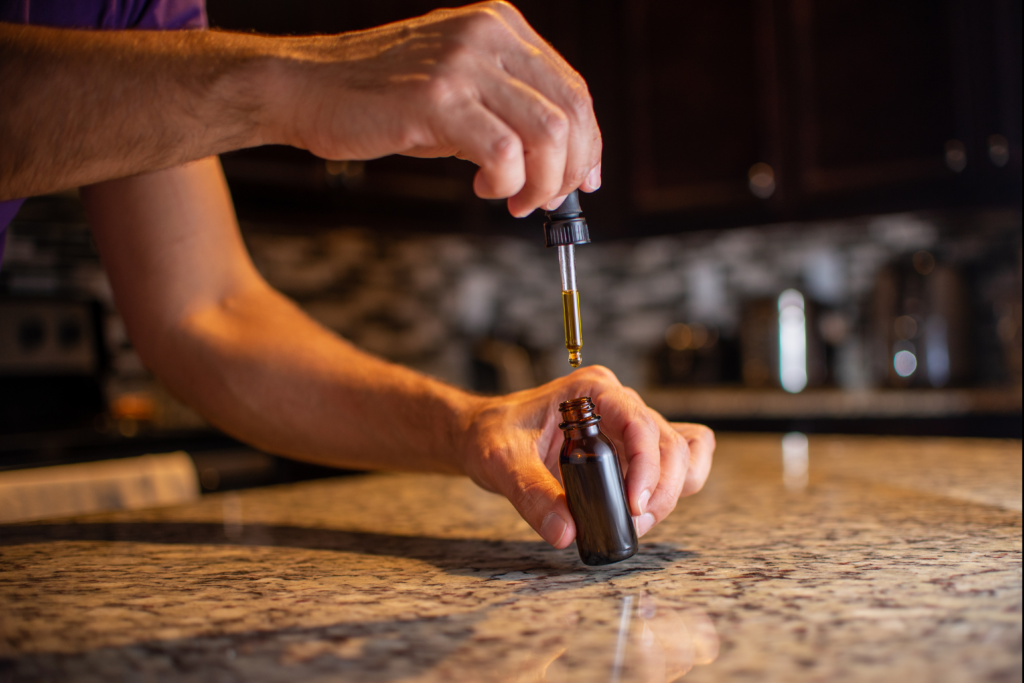
Using a tincture is simple once you have done it once. The most common method is sublingual:
Shake the bottle.Cannabinoids can settle, so a quick shake helps keep every dropper consistent.
Measure your amount.Use the marked dropper to draw up the amount you and your physician have discussed.
Place it under your tongue.Dispense the liquid beneath your tongue rather than on top of it.
Hold, don’t swallow right away.Let it sit for about 30 to 60 seconds so some of the dose can absorb through the tissue in your mouth, then swallow.
Wait before re-dosing.Give it time to take full effect before deciding whether to take more. Effects can continue to build for a while.
You can also add a tincture to food or a beverage. If you do, treat it like an edible: the onset will be slower and the effect longer-lasting.
A sensible approach to amount
A widely used principle among medical patients is “start low and go slow”—beginning with a small amount and adjusting gradually over time rather than all at once. How much is appropriate for you depends on your individual situation, and that decision belongs with your qualified physician, not a blog. Bring your specific product and its milligram strength to your appointment so the conversation is concrete.
Storage
Keep tinctures in a cool, dark place away from direct sunlight and heat, with the cap closed tightly. Light, air, and heat gradually degrade cannabinoids, so good storage protects both potency and consistency. As with all products, keep them sealed and out of reach of children and pets.
04 Onset and duration: what to expect
Timing varies from person to person and depends on your body, whether you have eaten, and how you take the tincture. The ranges below are general guides drawn from the pharmacology of cannabinoids—not promises—to help you set realistic expectations.
Method
Onset (general range)
Duration (general range)
Tincture, under the tongue
~15–45 minutes
A few hours
Tincture, swallowed / in food
~1–2 hours
Often longer (edible-like)
Nano / fast-acting tincture
Engineered for a faster, more consistent onset
Varies by formula
Inhaled (for comparison)
Seconds to minutes
Shorter
The big takeaway: a tincture sits between inhaling and a traditional edible. Hold it under your tongue and it leans faster; swallow it and it leans slower and longer.
05 The main tincture varieties
“Tincture” describes the format, not the contents. Once you know the format, the next questions are which cannabinoids, in what ratio, and how the formula is built.
Full-spectrum and RSO
RSO stands for Rick Simpson Oil, a thick, dark, full-spectrum extract that aims to capture the broad range of the plant’s compounds—many cannabinoids and terpenes together—rather than isolating just one. RSO is decarboxylated, meaning it has been gently heated so the cannabinoids are in their active form, and it is generally high in potency. Because it is so concentrated, RSO is typically used in very small amounts.
Cannabinoid ratios (like CBD to THC)
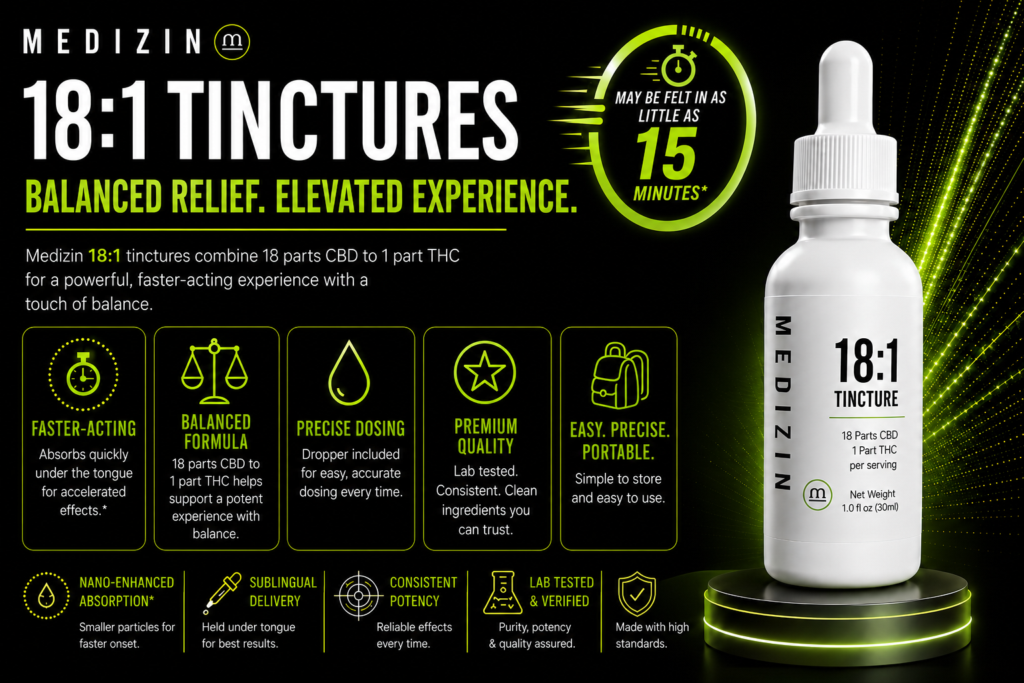
Many tinctures are labeled with a ratio, such as 18:1. That means 18 parts of the first cannabinoid to 1 part of the second—so an 18:1 CBD-to-THC tincture contains eighteen times as much CBD as THC. Higher-CBD, lower-THC ratios behave very differently from THC-forward products.
Ratios connect to an idea you will hear a lot: the “entourage effect.” This is a hypothesis—an active area of research rather than settled fact—that cannabinoids and terpenes may work together and shape one another’s effects. Notably, CBD is understood to influence how the body processes THC. The honest summary is that the science is still developing, and individual response varies.
Indica, sativa, and hybrid labels
You will also see tinctures sorted into indica, sativa, and hybrid. It is worth being candid here: the popular shorthand that “sativa energizes and indica relaxes” is widely debated among researchers and is not a reliable predictor of how a product will affect any given person. The cannabinoid and terpene profile—and your own body—matter more than the category name. Treat these labels as a starting point for a conversation, not a guarantee.
Nano (fast-acting) tinctures
Because cannabinoids don’t dissolve well in water, some modern tinctures use nanoemulsion technology. In simple terms, the oil is broken into extremely tiny droplets—measured in nanometers—that act like microscopic carriers. This is a well-established pharmaceutical technique for helping water-shy compounds dissolve and absorb more readily, and in a tincture it is designed to support a faster and more consistent onset.
06 Planet 13 Florida’s tincture lineup
Here is how three of the tinctures you will find with us map onto everything above. Strengths shown are total cannabinoid content per bottle as listed on the label; always confirm current specifics in-store or on the product’s lab report.
Full-Spectrum / RSO
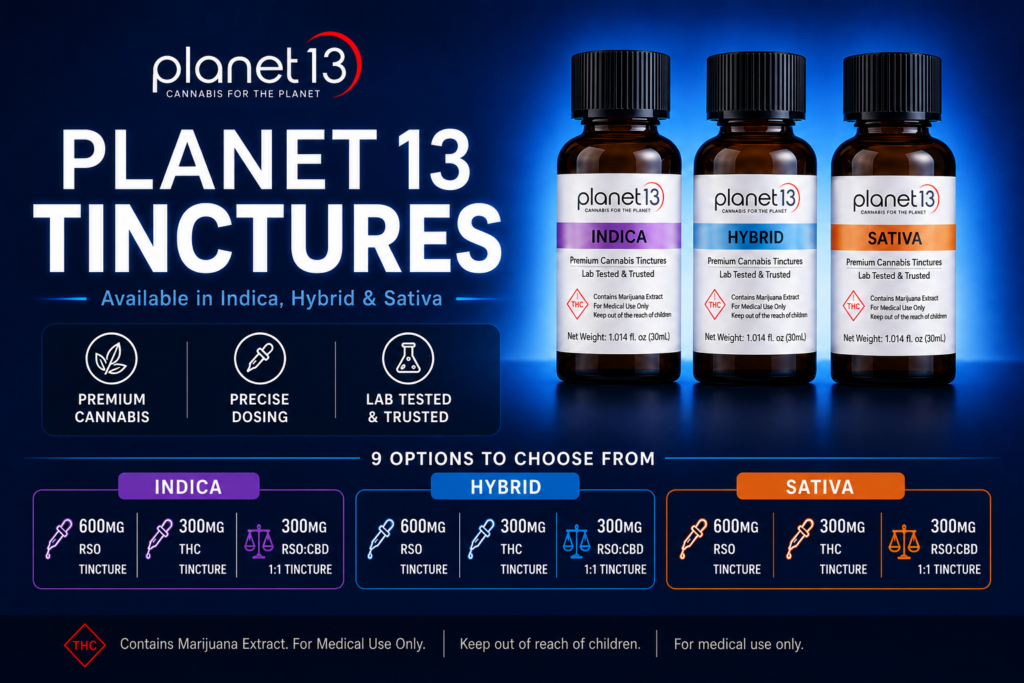
RSO Tincture
600 mg THC
A full-spectrum, decarboxylated whole-plant tincture at a high potency. RSO captures a broad range of the plant’s cannabinoids and terpenes together, making it the most concentrated option in this trio—and one that is typically used in very small amounts. A good fit to discuss with your physician if you are looking for a whole-plant, THC-forward format.
THC Tincture · Hybrid / Sativa / Indica
300 mg THC Tincture
300 mg THC Hybrid · Sativa · Indica
A THC-forward tincture offered across hybrid, sativa, and indica selections so you can choose based on the cultivar profile you prefer. At 300 mg per bottle, it is a moderate-strength, measured way to take THC without smoking. (See the note above on what the category labels do—and don’t—tell you.)
Medizin · High-CBD Ratio · Nano
18:1 CBD : THC Nano Tincture
18:1 CBD : THC Nanoemulsion
A high-CBD, low-THC ratio tincture—eighteen parts CBD to one part THC—built with nanoemulsion technology engineered to support faster, more consistent absorption. A CBD-forward option for patients who want minimal THC relative to CBD. As always, your physician can help you decide whether this ratio suits your goals.
07 How to read a tincture label and COA
Confidence in a tincture starts with the label and the Certificate of Analysis (COA)—the third-party lab report behind the product. A few things to look for:
Total cannabinoids per bottle (for example, 600 mg THC) and, where listed, per measured dropper.
The cannabinoid ratio, if the product is a ratio formula like 18:1.
The carrier and ingredients—such as the oil or alcohol base.
Batch / lot number that matches the COA, plus testing for potency and contaminants.
If you would like a deeper walkthrough, see our companion guide on reading a cannabis COA, along with our explainers on cannabinoids and terpenes.
08 Frequently asked questions
How long should I hold a tincture under my tongue?
About 30 to 60 seconds before swallowing. Holding it there gives some of the dose time to absorb through the tissue in your mouth, which generally leads to a sooner onset than swallowing it right away.
Will a tincture make me feel high?
It depends entirely on the formula. THC-forward tinctures (like a 300 mg THC or RSO product) contain meaningful THC, while a high-CBD ratio such as 18:1 contains very little THC relative to CBD. Always check the label and discuss what is appropriate with your qualified physician.
What does a ratio like 18:1 actually mean?
It is the proportion of one cannabinoid to another. An 18:1 CBD-to-THC tincture contains eighteen times as much CBD as THC.
What makes a “nano” or fast-acting tincture different?
Nano tinctures use nanoemulsion technology to break the oil into extremely small droplets. Because cannabinoids don’t dissolve easily in water, this approach is designed to help them absorb more readily and support a faster, more consistent onset.
How should I store my tincture?
In a cool, dark place away from sunlight and heat, tightly capped, and out of reach of children and pets. Light, air, and heat slowly degrade cannabinoids over time.
How do I know how much to take?
That is a decision to make with your qualified physician based on your individual circumstances. A common patient principle is to start low and adjust slowly. Bring the specific product and its milligram strength to your appointment.
Have questions about tinctures?
Our knowledgeable staff at Planet 13 Florida can walk you through the menu and help you find the format that fits your routine.Find a Planet 13 Florida location
About our sourcesThis article draws on established pharmacology of cannabinoids and routes of administration—including sublingual versus oral absorption, first-pass metabolism, and nanoemulsion drug-delivery science—as described in peer-reviewed and clinical reference literature. It is intended for general education only.
Important Compliance Notice
This content is provided for general educational and informational purposes only. It is not medical advice and is not a substitute for consultation with a qualified physician. Nothing here is intended to diagnose, treat, cure, or prevent any disease or medical condition, and no therapeutic outcome is claimed or implied.
Marijuana for medical use by qualified patients is regulated by the State of Florida. These products have not been analyzed or approved by the U.S. Food and Drug Administration (FDA). Marijuana may impair concentration, coordination, and judgment—do not operate a vehicle or machinery under its influence. Keep all products sealed and out of the reach of children and pets.
Individual results vary. Always follow the guidance of your qualified physician and the laws of the State of Florida. Must be a registered Florida medical marijuana patient to purchase.